Thursday, October 31, 2013

Feds proving Internet-adept and inept at same time

In these October 2013 photos, Director of National Intelligence James Clapper, left, and Health and Human Services Secretary Kathleen Sebelius testify at separate hearings on Capitol Hill in Washington. When it comes to the Internet, the Obama administration appears simultaneously to be a bungling amateur and a stealthy wizard. The same federal government that apparently intercepted communications to and from Google and Yahoo data centers without leaving a trace is facing scorn because it can't put together a working website for health care. (AP Photo)


In these October 2013 photos, Director of National Intelligence James Clapper, left, and Health and Human Services Secretary Kathleen Sebelius testify at separate hearings on Capitol Hill in Washington. When it comes to the Internet, the Obama administration appears simultaneously to be a bungling amateur and a stealthy wizard. The same federal government that apparently intercepted communications to and from Google and Yahoo data centers without leaving a trace is facing scorn because it can't put together a working website for health care. (AP Photo)


FILE - This Jan. 3, 2013, file photo shows a Google sign at the company's headquarters in Mountain View, Calif. When it comes to the Internet, the Obama administration appears simultaneously to be a bungling amateur and a stealthy wizard. The same federal government that apparently intercepted communications to and from Google and Yahoo data centers without leaving a trace is facing scorn because it can't put together a working website for health care. (AP Photo/Marcio Jose Sanchez, File)


WASHINGTON (AP) — When it comes to computers, the Obama administration appears simultaneously to be a bungling amateur and a stealthy wizard. The same government that reportedly intercepted the communications of America's leading consumer technology firms, Google and Yahoo, without leaving a trace is scorned because it can't build a working federal website for health insurance.

In a single day in the nation's capital, extremes of the impressive successes and stunning failures of the Internet age were on full display.

Computer professionals said the government can be both adept and inept at the same time because the tasks are so different and for reasons involving who is doing it, for how much money, how long it takes and how publicly it is done.

Under a classified project called MUSCULAR, the National Security Agency has secretly broken into the main communications links that connect Google and Yahoo data centers around the world, The Washington Post reported Wednesday, citing documents obtained from former NSA systems analyst Edward Snowden. In the past 30 days, the NSA swept up and processed more than 180 million new records, including metadata indicating who sent and received emails and when it happened, the Post reported.

Across town, Health and Human Services Secretary Kathleen Sebelius was apologizing to Congress over the bungled healthcare.gov website. New documents obtained by The Associated Press showed that officials had worried that a lack of website testing posed a potentially high security risk. In yet another conflict-riddled Capitol Hill hearing, a congressman told Sebelius that she had put Americans' personal financial information at risk.

The difference? National priorities, including big differences in how much the government spends, plus the talent and expertise of the people the government hires.

The NSA's annual budget was just over $7 billion in fiscal 2013, according to budget documents leaked by Snowden. The budget for the entire Health and Human Services Department was less than $1 trillion, and it spent $118 million on the website plus about $56 million on other IT to support the website, Sebelius said Wednesday.

The NSA is famous for employing small focused teams of highly talented, highly recruited experts with special skills, said Chris Wysopal, a former hacker who is chief technology officer for Veracode in Burlington, Mass. But the Health and Human Services Department's website designers? "They are sort of your average developers," he said.

Ex-hacker Marc Maiffret, who once wore his hair green in spikes and is the chief technology officer at BeyondTrust of San Diego, said Beltway contractors who work on civilian technology projects usually are over-budget and under-performing. Teams putting together large IT systems are complex and must coordinate across different government agencies, insurance companies, states and contractors.

"They may have underestimated the complexity when they started on it, which is again not surprising," said Purdue University computer science professor Gene Spafford.

Motivation is important too. Patriotic hacking on behalf of the NSA is exciting, especially among the mostly young and mostly male demographic.

"Breaking in, it feels like special ops," Wysopal said. "Building something feels probably like you're in the Corps of Engineers. You're just moving a lot of dirt around."

It's also widely understood to be easier to break something down than to build it. Siphoning the Google and Yahoo data is simpler to do than building a secure website for millions of people to get health care, Wysopal and Maiffret said.

Besides, if the NSA had failed to collect all the data it wanted during a classified mission, few people would learn about it — unlike what happened almost immediately when the health care website was launched and immediately experienced problems, said Matt Green, a computer science professor at Johns Hopkins University.

"If the NSA doesn't do something, you and I don't hear about it," Green said.

The government generally spends more money researching how to attack, not defend, computers, said Spafford, director of the Center for Education and Research in Information Assurance and Security at Purdue.

The apparent contradiction between health care and the NSA, Spafford said, "is what makes computers magical."

___

Center for Education and Research in Information Assurance and Security: http://www.cerias.purdue.edu/site/about

___

Follow Seth Borenstein on Twitter at http://twitter.com/borenbears

Associated PressSource: http://hosted2.ap.org/APDEFAULT/3d281c11a96b4ad082fe88aa0db04305/Article_2013-10-30-US-Technology-Two-Tales/id-856c2f3d4cc34be79e2243b652f1d030
Tags: GTA Online   Dumb and Dumber 2  

The ultimate guide to preventing DNS-based DDoS attacks


When it comes to DNS, Cricket Liu literally wrote the book. He has co-authored all five editions of O'Reilly's "DNS and BIND" book, which is generally regarded as the definitive guide on all things relating to the Domain Name System. Cricket is currently chief infrastructure officer at Infoblox.


DNS is clearly a critical component of computer networking, but there are times when these tools can be used for malfeasance. In this week's New Tech Forum, Cricket takes a look at the growing problem of DNS-based DDoS attacks and how to deal with them. -- Paul Venezia


DNS-based DDoS attacks: How they work and how to stop them
The DNS-based DDoS (distributed denial-of-service attack) has become one of the most common destructive attacks on the Internet. But how do they work? And what can we do to defend against them?


In this article, I'll describe how DDoS attacks both exploit and target DNS infrastructure. I'll also show you what you can do to protect yourself and others.


The big spoof
Generating a DDoS attack using DNS infrastructure is remarkably simple: The attackers send queries to name servers across the Internet, and those name servers return responses. Instead of sending the queries from their own IP addresses, though, the attackers spoof the address of their target -- which could be a Web server, a router, another name server, or just about any node on the Internet.


Spoofing DNS queries is particularly easy because they are usually carried over UDP (the connectionless User Datagram Protocol). Sending a DNS query from an arbitrary IP address is about as simple and has roughly the same effect as writing someone else's return address on a postcard.


Spoofing queries isn't enough to incapacitate a target, though. If the responses to those queries were no larger than the queries themselves, an attacker would do just as well to flood the target with spoofed queries. No, to maximize the damage to the target, each query should return a very large response. It turns out that's very easy to instigate.


Since the advent of EDNS0, a set of extensions to DNS introduced back in 1999, UDP-based DNS messages have been able to carry lots of data. A response can be as large as 4,096 bytes. Most queries, on the other hand, are fewer than 100 bytes in length.


Once upon a time, it was relatively difficult to find a response that large in the Internet's namespace. But now that organizations have begun deploying DNSSEC, the DNS Security Extensions, it's much easier. DNSSEC stores cryptographic keys and digital signatures in records in the namespace. These are positively enormous.


Source: http://images.infoworld.com/t/security/the-ultimate-guide-preventing-dns-based-ddos-attacks-229790?source=rss_infoworld_top_stories_
Related Topics: Bitstrips   Celia Cruz   michael beasley   apple event   twerk  

New look at old test may provide earlier detection of meningitis, MU researchers find

New look at old test may provide earlier detection of meningitis, MU researchers find


[ Back to EurekAlert! ]

PUBLIC RELEASE DATE:

30-Oct-2013


[


| E-mail

]


Share Share

Contact: Jeff Hoelscher
hoelscherj@missouri.edu
573-884-1608
University of Missouri-Columbia


COLUMBIA, Mo. ― Researchers from the University of Missouri School of Medicine have found a more accurate method to screen for bacterial meningococcal infection in its early stages, when it's hardest to detect. According to the researchers, the method for diagnosis could save lives by getting patients treatment earlier, when the infection is most treatable.


While meningococcal infection is relatively rare, affecting approximately 2,500 people per year in the United States, it is a devastating disease. It kills seven to 15 percent of those who acquire the infection, and often causes permanent complications for survivors, such as brain damage and hearing loss. Many patients also require amputation of limbs because the disease can cause severe tissue damage to extremities.


Immediate treatment is important in meningococcal infection because it usually progresses rapidly within eight to twelve hours. Some patients may die within as little as 12 to 24 hours after onset of symptoms, which can include a sudden high fever, severe headache, neck stiffness and mental confusion. About half of patients with the infection have a rash.


"When we talk about early diagnosis, we're not talking about days, but rather hours and even minutes," said Michael Cooperstock, M.D., professor of child health in the Division of Pediatric Infectious Diseases at the MU School of Medicine, medical director of infection control at University of Missouri Health Care and senior author of the study.


"Diagnosis of most bacterial infections traditionally has relied upon the detection of an increase in the total number of white blood cells," Cooperstock said. "That's because an increase in a patient's white blood cell count is an indication of acute inflammation associated with infection."


However, in their study of 216 cases from the U.S. Multicenter Meningococcal Surveillance Study, MU researchers found that 33 percent of the patients with active infections had total white blood cell counts that appeared normal. After examining the patients' blood tests more closely, the researchers found that a better indicator of infection was not the total white blood cell count but rather abnormalities in two particular types of white blood cells called neutrophils.


"When we looked at the neutrophil counts of each patient, we examined not only the total number of neutrophils, but also the number of immature neutrophils and the ratio of immature to total neutrophil cells," Cooperstock said. "We found that 94 percent of the patients showed an abnormality of one or more of these three tests, indicating a serious infection might be present. Reliance on the total white blood cell count alone, however, would have given false reassurance that infection was not present in more than 30 percent of those cases."


Neutrophils are the most abundant type of white blood cells, acting as first responders to help fight infection, particularly bacterial infections. Mature neutrophil cells are called segmented neutrophils, and immature cells are known as band neutrophils.


"Our study suggests that physicians should look not at the total white cell count but at the total number of neutrophils, the total number of band neutrophils and the ratio of band to total neutrophils as an indicator that could lead to a suspicion of meningococcal infection," Cooperstock said. "If any of the three neutrophil indicators are outside a certain range, there is a possibility that the patient has a serious bacterial infection, including the possibility of meningococcal disease, and would need careful attention."


Cooperstock also pointed out that although automated white cell counts, a method used in many emergency rooms and clinics, may be quicker, they do not measure neutrophil bands and could lead to a missed diagnosis.


"Our purpose with the publication of this study is to point out the best way to evaluate neutrophil counts when ordering blood analysis," Cooperstock said. "That's especially important for children with fever, who often may not present with typical meningococcal symptoms."


###

The study, "Altered Neutrophil Counts at Diagnosis of Invasive Meningococcal Infection in Children," was published in the October 2013 edition of The Pediatric Infectious Disease Journal: http://journals.lww.com/pidj/Abstract/2013/10000/Altered_Neutrophil_Counts_at_Diagnosis_of_Invasive.8.aspx.


[ Back to EurekAlert! ]

[


| E-mail


Share Share

]


AAAS and EurekAlert! are not responsible for the accuracy of news releases posted to EurekAlert! by contributing institutions or for the use of any information through the EurekAlert! system.


New look at old test may provide earlier detection of meningitis, MU researchers find


[ Back to EurekAlert! ]

PUBLIC RELEASE DATE:

30-Oct-2013


[


| E-mail

]


Share Share

Contact: Jeff Hoelscher
hoelscherj@missouri.edu
573-884-1608
University of Missouri-Columbia


COLUMBIA, Mo. ― Researchers from the University of Missouri School of Medicine have found a more accurate method to screen for bacterial meningococcal infection in its early stages, when it's hardest to detect. According to the researchers, the method for diagnosis could save lives by getting patients treatment earlier, when the infection is most treatable.


While meningococcal infection is relatively rare, affecting approximately 2,500 people per year in the United States, it is a devastating disease. It kills seven to 15 percent of those who acquire the infection, and often causes permanent complications for survivors, such as brain damage and hearing loss. Many patients also require amputation of limbs because the disease can cause severe tissue damage to extremities.


Immediate treatment is important in meningococcal infection because it usually progresses rapidly within eight to twelve hours. Some patients may die within as little as 12 to 24 hours after onset of symptoms, which can include a sudden high fever, severe headache, neck stiffness and mental confusion. About half of patients with the infection have a rash.


"When we talk about early diagnosis, we're not talking about days, but rather hours and even minutes," said Michael Cooperstock, M.D., professor of child health in the Division of Pediatric Infectious Diseases at the MU School of Medicine, medical director of infection control at University of Missouri Health Care and senior author of the study.


"Diagnosis of most bacterial infections traditionally has relied upon the detection of an increase in the total number of white blood cells," Cooperstock said. "That's because an increase in a patient's white blood cell count is an indication of acute inflammation associated with infection."


However, in their study of 216 cases from the U.S. Multicenter Meningococcal Surveillance Study, MU researchers found that 33 percent of the patients with active infections had total white blood cell counts that appeared normal. After examining the patients' blood tests more closely, the researchers found that a better indicator of infection was not the total white blood cell count but rather abnormalities in two particular types of white blood cells called neutrophils.


"When we looked at the neutrophil counts of each patient, we examined not only the total number of neutrophils, but also the number of immature neutrophils and the ratio of immature to total neutrophil cells," Cooperstock said. "We found that 94 percent of the patients showed an abnormality of one or more of these three tests, indicating a serious infection might be present. Reliance on the total white blood cell count alone, however, would have given false reassurance that infection was not present in more than 30 percent of those cases."


Neutrophils are the most abundant type of white blood cells, acting as first responders to help fight infection, particularly bacterial infections. Mature neutrophil cells are called segmented neutrophils, and immature cells are known as band neutrophils.


"Our study suggests that physicians should look not at the total white cell count but at the total number of neutrophils, the total number of band neutrophils and the ratio of band to total neutrophils as an indicator that could lead to a suspicion of meningococcal infection," Cooperstock said. "If any of the three neutrophil indicators are outside a certain range, there is a possibility that the patient has a serious bacterial infection, including the possibility of meningococcal disease, and would need careful attention."


Cooperstock also pointed out that although automated white cell counts, a method used in many emergency rooms and clinics, may be quicker, they do not measure neutrophil bands and could lead to a missed diagnosis.


"Our purpose with the publication of this study is to point out the best way to evaluate neutrophil counts when ordering blood analysis," Cooperstock said. "That's especially important for children with fever, who often may not present with typical meningococcal symptoms."


###

The study, "Altered Neutrophil Counts at Diagnosis of Invasive Meningococcal Infection in Children," was published in the October 2013 edition of The Pediatric Infectious Disease Journal: http://journals.lww.com/pidj/Abstract/2013/10000/Altered_Neutrophil_Counts_at_Diagnosis_of_Invasive.8.aspx.


[ Back to EurekAlert! ]

[


| E-mail


Share Share

]


AAAS and EurekAlert! are not responsible for the accuracy of news releases posted to EurekAlert! by contributing institutions or for the use of any information through the EurekAlert! system.


Source: http://www.eurekalert.org/pub_releases/2013-10/uom-nla102913.php
Category: david ortiz   What Does the Fox Say   What Is Labor Day   FOX Sports 1   Hyperloop  

After unity, Obama faces Democratic pushback

President Barack Obama gestures while speaking in the Rose Garden of the White House in Washington, Monday, Oct. 21, 2013, on the initial rollout of the health care overhaul. Obama acknowledged that the widespread problems with his health care law's rollout are unacceptable, as the administration scrambles to fix the cascade of computer issues. (AP Photo/Charles Dharapak)


President Barack Obama gestures while speaking in the Rose Garden of the White House in Washington, Monday, Oct. 21, 2013, on the initial rollout of the health care overhaul. Obama acknowledged that the widespread problems with his health care law's rollout are unacceptable, as the administration scrambles to fix the cascade of computer issues. (AP Photo/Charles Dharapak)


WASHINGTON (AP) — Just two weeks after President Barack Obama saw his Democratic Party put up an unyielding front against Republicans, his coalition is showing signs of stress.

From health care to spying to pending budget deals, many congressional Democrats are challenging the administration and pushing for measures that the White House has not embraced.

Some Democrats are seeking to extend the enrollment period for new health care exchanges. Others want to place restraints on National Security Administration surveillance capabilities. Still others are standing tough against any budget deal that uses long-term reductions in major benefit programs to offset immediate cuts in defense.

Though focused on disparate issues, the Democrats' anxieties are connected by timing and stand out all the more when contrasted with the remarkable unity the party displayed during the recent showdown over the partial government shutdown and the confrontation over raising the nation's borrowing limit.

"That moment was always going to be fleeting," said Matt Bennett, who worked in the Clinton White House and who regularly consults with Obama aides. "The White House, every White House, understands that these folks, driven either by principle or the demands of the politics of their state, have to put daylight between themselves and the president on occasion."

Obama and the Democrats emerged from the debt and shutdown clash with what they wanted: a reopened government, a higher debt ceiling and a Republican Party reeling in the depths of public opinion polls.

But within days, attention turned to the problem-riddled launch of the 3-year-old health care law's enrollment stage and revelations that the U.S. had been secretly monitoring the communications of as many as 35 allied leaders, including German Chancellor Angela Merkel. And with new budget talks underway, Democratic Party liberals reiterated demands that Obama not agree to changes that reduce Social Security or Medicare benefits even in the improbable event Republicans agree to increase budget revenues.

The fraying on the Democratic Party edges is hardly unraveling Obama's support and it pales when compared to the upheaval within the Republican Party as it distances itself from the tactics of tea party conservatives. But the pushback from Democrats comes as Obama is trying to draw renewed attention to his agenda, including passage of an immigration overhaul, his jobs initiatives and the benefits of his health care law.

The computer troubles that befell the start of health insurance sign-ups have caused the greatest anxiety. Republicans pounced on the difficulties as evidence of deeper flaws in the law. But Democrats, even as they defended the policy, also demanded answers in the face of questions from their constituents.

"The fact is that the administration really failed these Americans," Rep. Allyson Schwartz, D-Pa., told Medicare chief Marilyn Tavenner at a hearing this week. "So going forward there can be just no more excuses."

In the Senate, 10 Democrats signed on to a letter seeking an unspecified extension of the enrollment period, which ends March 31. "As you continue to fix problems with the website and the enrollment process, it is critical that the administration be open to modifications that provide greater flexibility for the American people seeking to access health insurance," Sen. Jeanne Shaheen, D-N.H., wrote.

Another Democratic senator, Joe Manchin of West Virginia, has called for a one-year delay in the requirement that virtually all Americans have health insurance or pay a fine.

Democrats who have talked to White House officials in recent days describe them as rattled by the health care blunders. But they say they are confident that the troubled website used for enrollment will be corrected and fully operational by the end of November.

The spying revelations also have created some tensions between the administration and Democrats. Sen. Dianne Feinstein, chairwoman of the Senate Intelligence Committee and until now a staunch supporter of the NSA's surveillance, called for a "total review of all intelligence programs" following the Merkel reports.

She said that when it came to the NSA collecting intelligence on the leaders of allies such as France, Spain, Mexico and Germany, "Let me state unequivocally: I am totally opposed."

With Congress renewing budget talks Wednesday, liberals have been outspoken in their insistence that Democrats vigorously resist efforts to reduce long-term deficits with savings in Social Security or Medicare. Sen. Bernie Sanders of Vermont, an independent who usually votes with Democrats, has been the most outspoken, saying he fears a budget deal will contain a proposal in Obama's budget to reduce cost-of-living adjustments for Social Security and other benefit programs.

Obama, however, has proposed that remedy only if Republicans agree to raise tax revenue, a bargain that most in the GOP firmly oppose. Moreover, leaders from both parties as well as White House officials have signaled that budget talks are looking for a small budget deal, not the type of "grand bargain" that would embrace such a revenue-for-benefit-cuts deal.

Associated PressSource: http://hosted2.ap.org/APDEFAULT/89ae8247abe8493fae24405546e9a1aa/Article_2013-10-31-US-Obama-Democrats'-Angst/id-143af21f1fe14eeb9aa8243997f37582
Related Topics: cnet   new england patriots   Cloudy With A Chance Of Meatballs 2   Mexico vs Honduras   lamar odom  

iPad Air preview

Everything you need to know about Apple's 5th generation 9.7-inch tablet, the iPad Air

3 years after Steve Jobs introduced the first magical and revolution iPad, Apple has kept the same unbelievable price but once again set the bar higher when it comes to their most advanced technology. It's still 9.7-inches. It's still a Retina display. It still runs the over one million apps - almost half of which are now tablet optimized - in the App Store. But it's once again thinner, lighter, and faster. Only this time it's even thinner and lighter, and the speed boost? On paper at least, insane. If you're thinking of upgrading to an iPad Air, however, or of buying one as your first full-sized iPad, what does that mean to you?

iPad evolution

iPad Air design

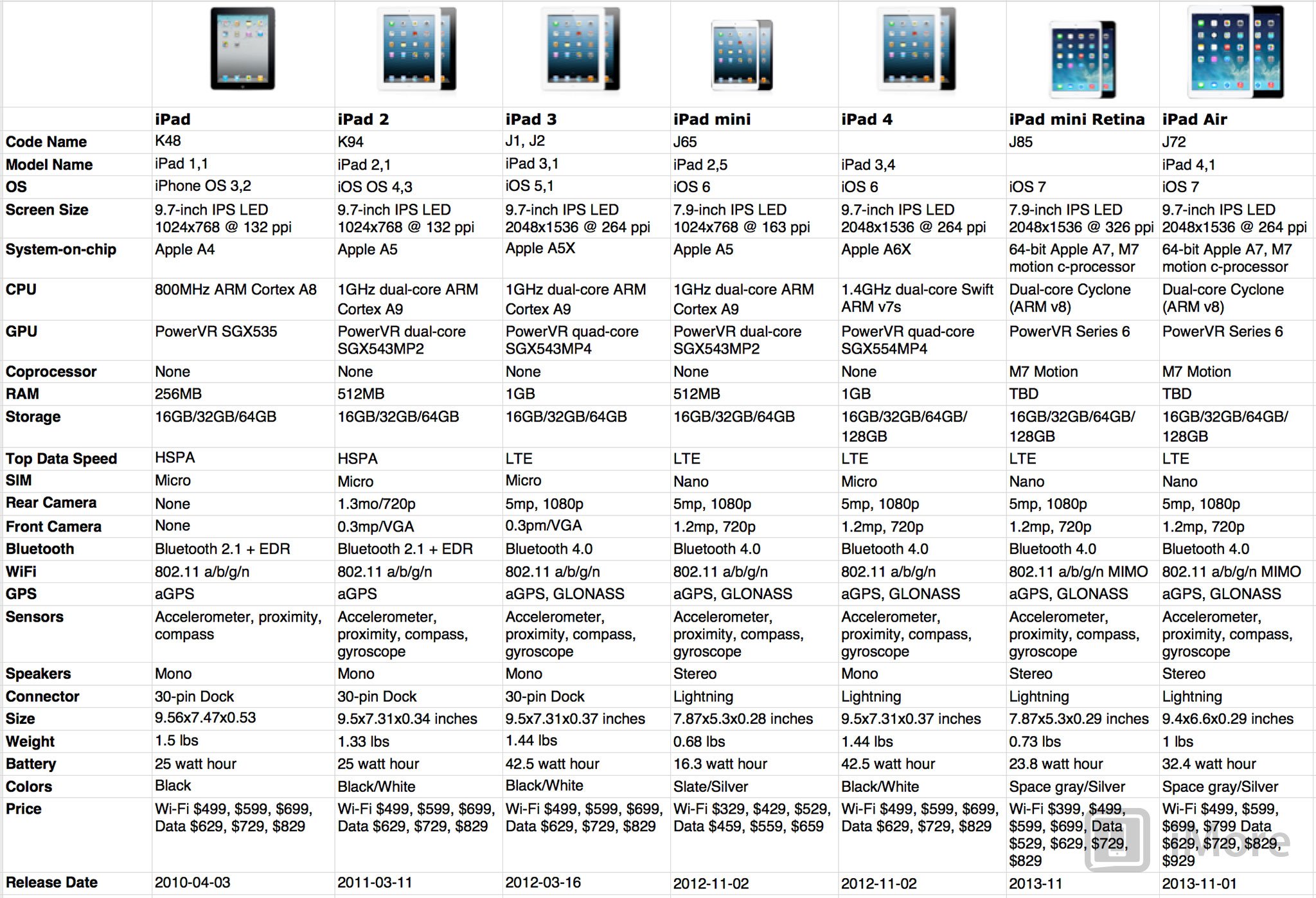
The original iPad, revolutionary as it was, was 0.5-inches thick and weighed 1.5lbs. That was nothing compared to the netbooks of the time, but it meant you couldn't hold it up for a long time without tiring yourself out. The iPad 2 thinned things out, and lightened them somewhat, coming in at 0.34-inches and 1.33lbs, but it remained more - ironically - a laptop or tabletop than a palmtop. The iPad 3 and iPad 4 were both ever-so-slightly thicker and heavier, thanks to the Retina tax. It took the iPad mini to really transform Apple's tablet from portable to truly mobile. 0.28-inches and 0.68lbs. Yet, to do it, it took the 9.7-inch screen to 7.9-inches, and shed Retina along the way. What about those who wanted a full-sized screen and an ultra-light, truly mobile design?

Enter the iPad Air.

From the minute the iPad mini was introduced, the iPad Air became a matter of speculation, then rumor. Now, reality. 0.29-inches thin, 1.0lbs light, it's closer to the iPad mini than its direct ancestor, the iPad 4. The difference works out as follows - 28% lighter, 20% thinner, 24% less volume. It's sounds, very nearly, like the best of all worlds.

I can't even imagine the engineering skill and effort required to trim the full-sized iPad down to its new, Air-y size and weight. Every hundredth of an inch was no doubt a battle against the laws of physics and economics. Yet by all appearances, it looks like Apple won.

The casing is that of the iPad mini stretched across the full-sized iPad screen. 9.7-inches of screen, a FaceTime HD camera, and a Home button - sans Touch ID, barely covered by aluminum. Like the iPhone 5 last year. the size will not properly inform the weight. It'll feel ridiculously light. Like a fake. A toy.

The look will be pure iPad mini as well, in color as well as casing. The black faceplate will be accompanied by a space gray back, both easier to anodize and more resistant to chips and scratches than the slate gray that came before it. The white faceplate will be accompanied by silver, a clear coat Apple's been using since last year. There'll be no gold option, however. Turns out you can have too much of a good thing.

If all of this makes it sound like the iPad Air is really just a slightly bigger iPad mini, then that sounds about exactly right. As always, Apple has leveraged technology created for one product across the line. The iPad Air, in every way, seems an iPad mini grown up more than an iPad 4 shrunk down.

And that might be the very best thing about it.

iPad Air A7 chipset

Everything you need to know about Apple's all-new 64-bit A7 system-on-a-chip, and the next generation Cyclone processor

Previously the full-sized iPads required a special variant of Apple's in-house chipsets in order to push around their massive 2048x1536 Retina displays. The A5X quad-core GPU on the iPad 3 was barely up to the task and Apple replaced it 6 months later with an Apple A6X, based on their first custom-CPU, the Swift. Now, the monstrous Apple A7 doesn't need no X to drive the iPad Air. It only needs it's next-generation custom-CPU, the Cyclone, and a PowerFX Series 6 "Rogue" GPU. It's 64-bit. It's desktop-class. It supports OpenGL ES 3.0. It includes an Apple M7 motion coprocessor. In Jobsian vernacular, it's a screamer.

The A7 is ridiculous in the iPhone 5s. It probably won't be as ridiculous in the iPad Air, but it will almost certainly be every bit as impressive.

Sadly, in addition to the lack of a TouchID sensor - blame supply constraints? - the image signal processor (ISP) that provides for everything from burst mode to slow-motion video on the iPhone 5s doesn't seem to be doing that on the iPad Air, at least not yet. Still, all the image quality magic should be there, and should be great.

It's also hard not to imagine the quality of apps we'll be getting - everything from the new iWork and iLife suites, to the already released djay 2 and Infinity Blade 3 - are going to once again redefine expectations for mobile software.

It's a big deal.

iPad Air FaceTime HD camera

The iPad Air didn't get an improved iSight camera this year - it's still 5mp/1080p - but it did get the same improved FaceTime HD camera Apple gave the iPhone 5s and iPhone 5c. That translates into a 1.9 micron pixel size and a back illuminated sensor, and means better low-light... for noir-style selfies and late-night FaceTime calls alike.

It's a nice to have, but for most people, certainly not a must have.

iPad Air MIMO Wi-Fi and more LTE

The iPad Air didn't get 802.11ac Wi-Fi like Apple's Mac line did, but it got multiple-input and multiple-output (MIMO). That means there's multiple antennas both sending and receiving, which makes the iPad Air less susceptible to interference. Apple claims that not only makes the iPad Air's Wi-Fi more robust, but faster as well. Twice as fast, at up to 300Mbps,

4G - the real kind, long term evolution (LTE) - has also gotten a boost for the iPad Air. Just like with the new iPhones, Apple is supporting more bands for more places. LTE, it turns out, is more of a mess than the name implies, with different carriers around the world spread across around 40 distinct segments of spectrum. Apple is trying to support as many of them as possible, in as many places as possible. Here's their current list:

  • UMTS/HSPA/HSPA+/DC-HSDPA (850, 900, 1700/2100, 1900, 2100 MHz); GSM/EDGE (850, 900, 1800, 1900 MHz)
  • CDMA EV-DO Rev. A and Rev. B (800, 1900 MHz)
  • LTE (Bands 1, 2, 3, 4, 5, 7, 8, 13, 17, 18, 19, 20, 25, 26)

Of course, Bluetooth 4.0 Low Energy (LE) is along for the ride, which enables all sorts of really interesting technologies, like the new tap-to-setup Apple TV feature, and, of course, iBeacons.

The lack of 802.11ac is a bummer, but everything else looks top flight.

iPad Air buyers guide

There's a lot to consider before you buy or upgrade to a new tablet, even a new iPad Air. Should you consider a MacBook Air instead? A Retina iPad mini? If you do go with an iPad Air, which color, what capacity, and if you want cellular data, on which carrier? There's never been more to choose from, which means it's never been harder to choose!

iPad Air bottom line

The iPad Air looks in every way to be the realization of the potential first seen in the original iPad. Years in the making, it has an incredible display, and unbelievable processor, phenomenal connectivity, and decent optics all rolled up in a package so thin and light it's hard to believe it's real. Add to that the hundreds of thousands of tablet-optimized apps available in the App Store, and it's hard to see anyone else getting close to what Apple's offering any time soon.

It's not a non-name, sub-$100 video player, and it's not a keyboard intermediated laptop replacement. It's an iPad. The new, full-sized iPad. The new features might all smack of technology, but they'll all add up to experience.

I'll be lining up in Montreal, in the cold, on Halloween night to get my hands on one, and I'll be back with a full review once I've spent a good chunk of time with it. But I haven't been this excited for an Apple tablet since the original. I'll be getting a Retina iPad mini for travel and for tethering. For home, for video, for comic books, for fingerprinting with productivity, and for touch the future, I'll be living with the iPad Air. At least until next year.


Source: http://feedproxy.google.com/~r/TheIphoneBlog/~3/XbNAMTc5K88/story01.htm
Category: dodgers   Wally Bell   Rihanna Pour It Up Video   courtney stodden   apple stock  

Minka Kelly Attends FOX's "Almost Human-(hattan)" Experience

Stepping out for a promotional event on Wednesday (October 30), "Almost Human's" Minka Kelly attended the Almost Human-(hattan) Experience in Herald Square New York City.


Looking exquisite in the chilly Big Apple air, the 33-year-old wore a trench coat over a lovely teal dress, sporting a pair of nude heels.


According to the SciFi & Fantasy Review, "FOX will recreate 2048 in the middle of Manhattan with the ALMOST HUMAN-(hattan) Experience."


The website states that "This fun and futuristic experience will feature a build out showcasing some of the coolest elements from the series including: Kennex’s police car, two spider police motorcycles, Rudy’s lab (complete with droids hanging from meat hooks) and “the recollectionist chair,” as well as a street team of MX-34 android policemen."


Source: http://celebrity-gossip.net/minka-kelly/minka-kelly-attends-foxs-almost-human-hattan-experience-952476
Category: hocus pocus   Pumpkin Carving Ideas   Tom Clancy   harry potter   Samsung  

ASUS and Samsung gain wide swaths of tablet market share in Q3


Samsung up to 20 percent of tablet market share, iPad and Windows feeling the hurt


IDC has posted third quarter market share estimates which show that Android tablet makers had an exceptional summer. Samsung jumped more than two points over its Q2 results, claiming 20.4 percent of shipments; ASUS also thrived during the period, moving up from just 4.5 points in the second quarter to 7.4 percent three months later. Both saw big year-over-year gains, although they didn't grow as quickly as up-and-comers like Acer and Lenovo. It's not hard to see why ASUS and Samsung made such large strides -- both the Galaxy Tab 3 line and the new Nexus 7 launched in the summer.


Things weren't quite as rosy for other tablet designers. While Apple was still the top manufacturer, it slipped below 30 percent in market share. IDC hasn't yet broken down shipments by OS, but it notes that the "others" category -- including Amazon, Microsoft and other small players -- shrank slightly to 35.3 points. The field is very likely to change in the fourth quarter between new iPads, the Kindle Fire HDX and Surface sequels. For now, though, it appears that the tablet market is shifting toward the giants of the Android world.


Source: http://www.engadget.com/2013/10/30/idc-tablet-share-q3-2013/?ncid=rss_truncated
Related Topics: Nothing Was The Same Leak   Julius Thomas   Kendra Spears   Ncaa Football Scores   Lauren Silverman